

Disclaimer: When you buy through links on our site, we may earn an affiliate commission at no extra cost to you.
A bumpy lawn is more than just an eyesore that makes your mower bounce around – it’s a rolled ankle waiting to happen. Whether your uneven yard is caused by heavy machinery, freezing and thawing cycles, or just years of natural settling, fixing it is a priority for any lawn enthusiast.
If you search online for how to level a bumpy lawn, 90% of the advice will tell you to simply “spread leveling sand over the bumps.”
If you have heavy or clay-heavy soil, do not do this. When I first started repairing my deeply rutted 1,000 sqm lawn, I learned the hard way that mixing sand with heavy soil creates something that resembles concrete. Here is the true “Mender’s Method” for safely leveling a bumpy lawn and the exact tool you need to get that golf-course smooth finish.
The Trap: Why Sand + Heavy Soil = Concrete
Sand is fantastic for leveling golf courses or lawns that already have sandy loam soil. It flows easily into low spots and drains well.
However, clay soil consists of microscopic, tightly packed particles. When you add coarse sand to clay, the tiny clay particles fill in the gaps between the larger sand grains. When it dries, it locks together. You are essentially mixing the basic ingredients for brick mortar right on your grass.
Once this hardens, water can’t penetrate it, roots can’t grow through it, and you will end up with dead, hard patches scattered across your yard.
The Solution: The “Mender’s Leveling Mix”
Instead of sand, you need a mix that provides structure but also feeds the soil and improves drainage.
The Ideal Mix:
- 30% Compost or Peat Moss: This adds organic matter that lightens the soil, holds the right amount of moisture, and feeds the existing grass.
- 70% High-Quality Topsoil: This provides the bulk to fill the deep holes and ruts without hardening.
Read more
The Essential Tool: The Lawn Leveling Rake
You cannot get a perfectly smooth lawn with a standard garden rake or a push broom. A garden rake will just dig into the soil and pull up your grass, while a broom isn’t heavy enough to push the dirt down into the low spots.
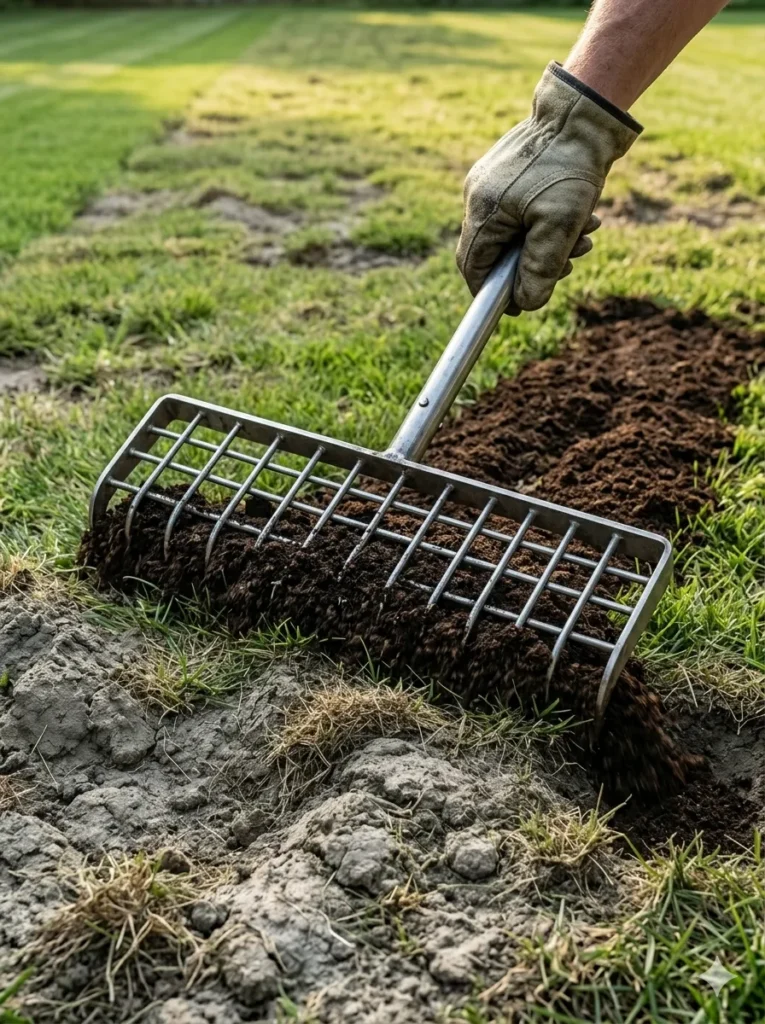
To do this right, you need a Lawn Leveling Rake (sometimes called a leveling lute). This is a wide, flat metal grid mounted on a long handle. As you push and pull it over the grass, the grid catches the soil mix and deposits it exactly into the low spots while gliding smoothly over the high spots.
If you want the job done fast and flawlessly, investing in a heavy-duty leveling rake is non-negotiable. It is the secret weapon of every professional greenskeeper.
Many homeowners make the mistake of using a standard leaf or garden rake for this step. However, investing in the best lawn leveling rake is the only way to truly flatten out dips and ruts permanently.
Mender’s Tip
Step-by-Step: How to Level Your Lawn
Follow these steps to level your lawn and get that golfcourse smoothness.
Step 1: Mow Low and Clean Up
You need the leveling mix to reach the soil, not sit on top of the grass blades. Mow your lawn a notch or two lower than usual. Bag the clippings so the area is clean.
Step 2: Aerate the High Spots (Crucial!)
Often, the “high spots” in a bumpy lawn are actually areas of severely compacted soil that have been pushed up. Before you add soil to the low spots, use a manual core aerator to relieve the pressure in the bumps.
Need a tool for this?
Step 3: Dump and Spread
Pour your Topsoil/Compost mix directly into the low spots. Do not apply more than 1/2 inch to 1 inch of soil at a time. If you completely bury the grass blades, the grass will suffocate and die.
Step 4: Work It In
Take your Lawn Leveling Rake and push the mix back and forth. You will immediately see the magic of this tool—the grid forces the dirt down into the gaps while keeping the grass blades standing up through the openings.
Step 5: Water and Wait
Give the area a light, gentle watering. This settles the soil into the low spots and washes the dust off the grass leaves so they can photosynthesize. Within a week or two, the grass will push through the new soil, and your bumpy ankle-breaker will be a thing of the past.
Frequently Asked Questions
There are no dumb questions, feel free to contact me if you are looking for answers not found here.
What is the best dirt mix to level a bumpy lawn?
For minor bumps, a 50/50 mix of screened topsoil and sharp sand (mason sand) is the standard choice. However, if you have heavy clay soil, avoid applying pure sand, as mixing sand with heavy clay can create a concrete-like texture. For clay lawns, a mix rich in organic compost and topsoil is highly recommended to improve the soil structure while leveling out the ruts.
Can you just put dirt over grass to level it?
Yes, but only in thin layers. You can safely apply up to 1/2 inch of leveling mix directly over your existing grass at a time. It is crucial that the grass blades are still visible and poking through the soil mix so they can get sunlight. If you have deep ruts or holes deeper than 2 inches, you must lift the existing turf with a shovel, fill the hole underneath, put the turf back, and reseed.
Should I aerate my lawn before leveling it?
Absolutely. If your lawn is bumpy because of compacted clay soil, core aeration is a necessary first step. Puncture holes in the lawn allows your new leveling mix and compost to fall deep into the soil profile rather than just sitting on top. This permanently improves underground drainage and prevents the low spots from turning into muddy puddles.
Will a bumpy lawn fix itself over time?
Unfortunately, no. Bumps and ruts caused by settling soil, frost heaving, or heavy lawnmower tires will usually get worse over time. Low spots collect water, which softens the clay further and causes deeper ruts. Manual intervention—through core aeration, topdressing, and using a lawn leveling rake—is required to get a permanently smooth yard.
As an Amazon Associate I earn from qualifying purchases.