
Disclaimer: When you buy through links on our site, we may earn an affiliate commission at no extra cost to you.
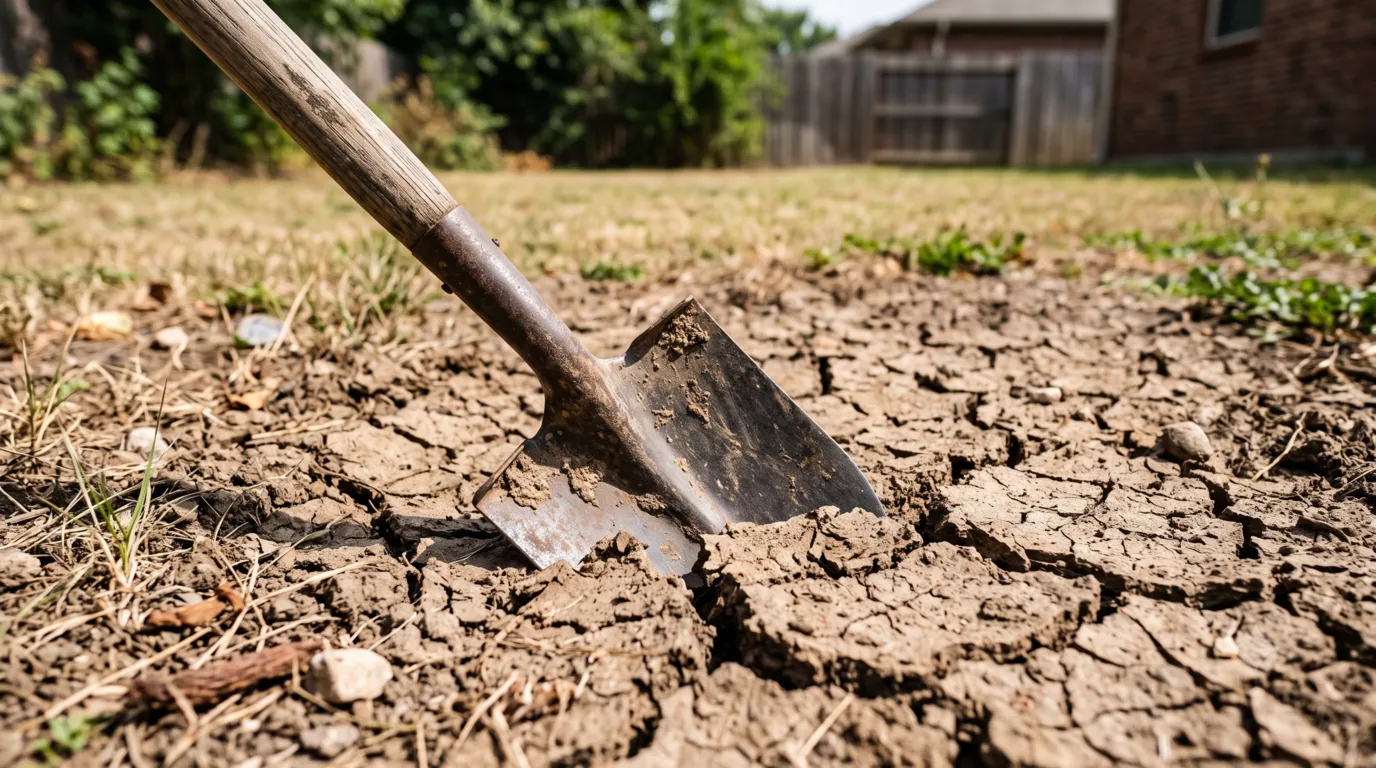
It is one of the most intuitive, common-sense thoughts a frustrated homeowner can have. You look out at your backyard, and it’s an absolute mess. During the wet spring months, it is a sticky, boot-sucking swamp of heavy clay. During the scorching summer months, it dries out and shrinks, forcing you to spend hours researching how to repair deep clay soil lawn cracks.
You know that sand is the exact opposite of clay. Sand is gritty, loose, and allows water to drain away with ease. Naturally, you reason that if you buy a few cubic yards of sand, dump it across your lawn, and rototill or rake it into the ground, the two materials will blend together. You expect to create a beautiful, loose, loam-like soil where grass roots can thrive.
Unfortunately, soil science does not work this way. In fact, adding pure sand to heavy clay soil is one of the absolute worst mistakes you can make for your turf.
Instead of fixing your drainage issues, you will likely end up creating a subterranean layer of low-grade, unreinforced concrete.
Before you grab a shovel, rent a tiller, or call a local quarry, let’s dive deep into the fascinating, frustrating physics of soil mechanics to understand why sand ruins clay lawns—and discover the proven, professional methods that actually soften hardpan earth.
1. The Particle Physics: Why Sand and Clay Don’t Mix
To understand why this combination fails so spectacularly, we have to look at soil under a microscope. Soil texture is determined by the percentage of three main mineral particles: sand, silt, and clay. The defining difference between them isn’t what they are made of, but rather how incredibly different they are in size and shape.
The Scale of Soil Particles
- Sand Particles: These are the giants of the soil world. A single grain of coarse sand measures between 0.05 mm and 2.0 mm in diameter. They are irregular, rough, and spherical. If a clay particle were the size of a coin, a single grain of sand would be the size of a massive, multi-story house.
- Clay Particles: Clay particles are microscopic, measuring less than 0.002 mm. Beyond being tiny, they are shaped like flat, microscopic plates or sheets of paper, carrying a negative electrical charge that causes them to pack tightly together.
The Packing Problem
When you have a yard made of pure clay, those flat, microscopic plates stack tightly on top of one another. When you dump large, coarse sand grains into that matrix, the sand grains do not push the clay apart. Instead, the millions of tiny, flat clay plates float directly into the wide-open gaps, nooks, and crannies between the larger sand grains.
Imagine filling a bucket with large rocks (the sand). There is plenty of open space between those rocks for water to flow through. Now, pour a bag of fine flour (the clay) into the bucket and shake it. The flour fills every single microscopic void between the rocks. The result is a completely solid, dense mass with zero remaining air pockets.
2. The Chemistry of Unintentional Mortar
In the construction and masonry industries, engineers use a very specific recipe to create mortar, bricks, and rudimentary concrete. They mix coarse sand, a fine binding agent (like silt, clay, or cement powder), and water.
When you apply sand to a clay lawn, you are accidentally executing this exact industrial recipe in your backyard.
- The Ingredients: Microscopic Clay Plates + Coarse Sand Grains
- The Catalyst: Summer Heat & Water Evaporation
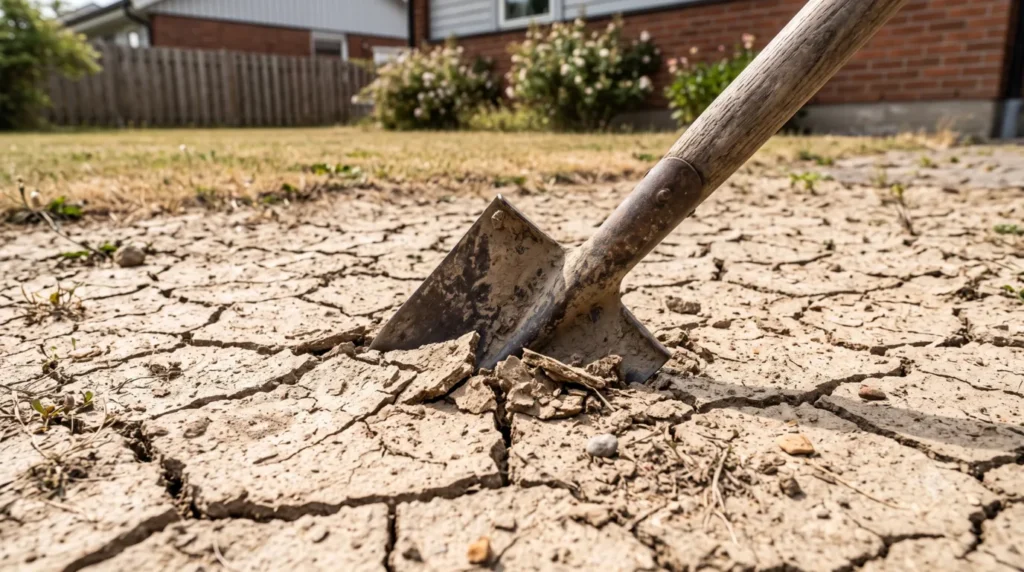
- The Result: A baked, rock-hard Crust
During a summer heatwave, the sun beats down on your yard. If you haven’t established proper summer mowing heights to shade the ground, the sun will rapidly evaporate every drop of moisture from the top layer of soil.
As the moisture leaves the sand-and-clay mixture, the negative electrical charges of the clay particles pull everything together into a tight, chemical bond. The sand grains act as an aggregate filler, locking the structure in place. Your soil transforms from a living ecosystem into a baked, rock-hard hardpan crust that is nearly impossible to penetrate with a standard garden shovel.
3. The Four Disasters of a “Sanded” Clay Lawn
If you have already added sand to your clay lawn, or if you are considering doing it, it is vital to know the long-term consequences. This mistake triggers a domino effect of structural problems that can take years to reverse.
I. Complete Root Suffocation
Grass roots are living organisms. They do not just drink water and absorb nutrients; they actively breathe oxygen. In healthy loam soil, roughly 50% of the soil volume consists of open pore spaces filled with air and water.
When clay plugs up the gaps between sand grains, those vital air pores vanish. Trapped beneath a dense, concrete-like crust, your lawn’s root system is completely starved of oxygen. The roots will begin to wither, shorten, and die, leaving your turf incredibly weak and unable to support healthy top growth.
II. Severe Water Shingling and Runoff
You might think adding sand will help water sink into the ground, but it achieves the exact opposite. Because the micro-pores are sealed, the surface tension of the hardened clay-sand crust becomes incredibly high.
When you irrigate or experience a heavy summer downpour, the water cannot penetrate the surface. Instead of soaking deep into the root zone, the water simply sits on top of the crust or runs off into the street. This leaves you trapped in a cycle where you are constantly trying to figure out how to water a clay lawn deeply without causing massive pooling, soil erosion, and waste.
III. Radical Nutrient Starvation
Clay soil is notorious for being difficult to work with, but it does have one massive superpower: Cation Exchange Capacity (CEC). Because clay particles are negatively charged, they excel at holding onto vital, positively charged nutrients like potassium, calcium, and magnesium.
Pure sand, on the other hand, has a CEC close to zero. It cannot hold onto nutrients. When you dilute your clay soil with sand without adding organic matter, you drastically reduce the soil’s natural ability to store food for your grass. Every time you fertilize, the nutrients wash right past the shallow root zone, leaving your lawn perpetually hungry and pale.
IV. Accelerated Heat Stress
A dense, compacted mixture of sand and clay acts as an excellent thermal conductor. During mid-summer, this rock-hard layer absorbs solar radiation and heats up rapidly, driving soil temperatures sky-high. This intense subsurface heat cooks the shallow grass roots, causing the lawn to enter a premature state of dormant heat stress, turning your beautiful green yard into a patchy, yellowing wasteland.
4. The Real Fix: Core Aeration and Organic Flocculation
If sand is completely off the table, how do you actually loosen heavy clay soil? The secret lies in changing the structure of the soil rather than its mineral texture. You cannot easily change the physical particles you were dealt by nature, but you can alter how those particles clump together.
The gold standard process for transforming clay involves two steps: Mechanical Extraction and Organic Flocculation.
Step 1: Mechanical Extraction via Core Aeration
To break the compaction of clay, you must physically remove pieces of it from the ground. Liquid solutions or topdressings applied directly onto compacted clay will simply run off.
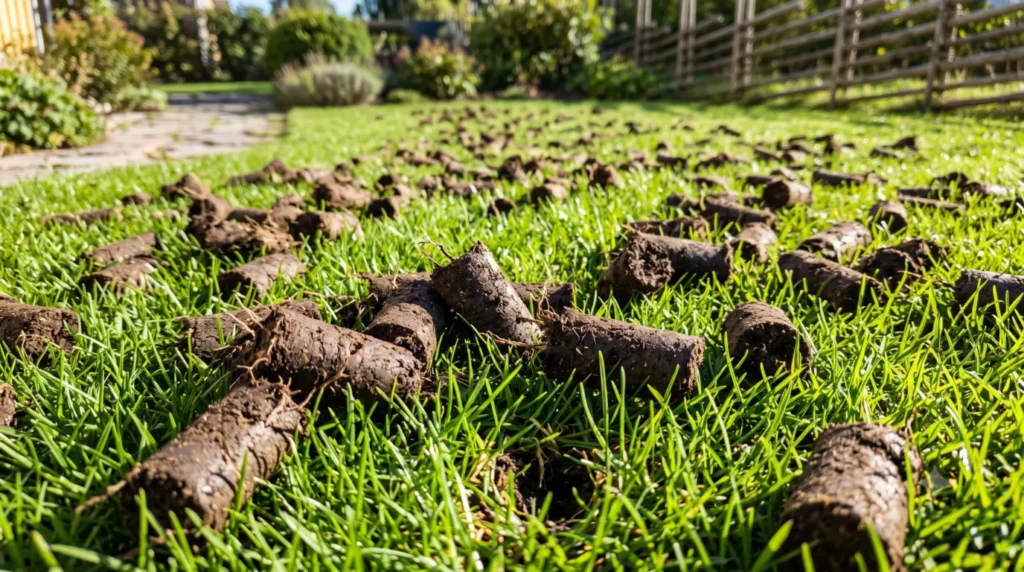
You need to use a machine that pulls actual soil cores out of the ground. For large yards, choosing the best tow-behind plug aerator allows you to use a riding mower or ATV to punch thousands of deep, hollow holes through the hardpan layer. This immediately relieves lateral pressure in the soil, allowing oxygen, water, and nutrients to plunge deep into the root zone.
Step 2: Topdressing with Rich Organic Matter
Once your lawn is full of open aeration holes, it is time to apply the real antidote to clay: Compost, leaf mold, or aged manure.
Unlike sand, organic matter is packed with microscopic life, humic acids, and organic compounds. When you spread a 1/4-inch layer of high-quality compost over the aerated lawn and smooth it out using a high-quality lawn leveling rake, the organic material falls directly into the open aeration channels.
- Step 1 (Core Aeration): Opens deep physical channels in the hardpan clay.
- Step 2 (Compost Application): Fills those open channels with rich microbes and humic acid.
- Step 3 (Microbial Action): Soil biology forces the tiny clay plates to group together into larger clusters (Flocculation).
As earthworms, beneficial bacteria, and fungi feast on the compost, they pull the organic matter deeper into the clay. This creates large, natural structural channels for water and air, permanently softening the ground over time.
5. The Advanced Chemical Shortcut: No-Dig Surfactants
For homeowners who want to speed up the softening process without spending days pushing heavy machinery or shoveling tons of compost, modern lawn care offers a highly effective shortcut.
By utilizing advanced, non-toxic liquid soil looseners, you can chemically alter the surface tension of tightly bound clay particles. These liquid surfactants work at a molecular level, forcing the stacked clay sheets to release their tight grip on one another.
If you are interested in a less physically demanding approach, you can learn the exact step-by-step method for fixing clay soil without intensive digging. When paired with regular deep watering, these liquid treatments allow moisture to sink past the sun-baked crust, keeping the clay soft, porous, and highly receptive to root growth without changing the physical texture with dangerous aggregates like sand.
6. Comprehensive FAQ: Sand and Lawn Care Myths
Can I use sand if I mix it with a massive amount of compost?
Yes, but the ratios required are immense. To successfully create a sandy-loam soil using sand and clay, sand must make up at least 60% to 70% of the total soil volume. For a standard residential yard, this would require dumping dozens of dump trucks of sand and tilling it a foot deep. If you don’t add enough sand to hit that high percentage, you automatically default to the concrete formula. It is far safer, cheaper, and easier to stick exclusively to pure organic compost.
Why do golf courses use pure sand on their greens?
This is a very common source of confusion. Golf courses do build their putting greens out of pure sand (often built to USGA specifications), but they are not mixing sand into existing clay. They excavate the earth several feet deep, install complex gravel drainage networks and pipes, and fill the entire basin with pure, engineered sand. Furthermore, managing a sand-based green requires industrial fertilizers, daily watering, and professional-grade aeration that the average homeowner cannot replicate.
Is there any safe way to use sand on a lawn?
The only safe application of sand on a residential lawn is as a very minor component in a topdressing mix used purely for leveling out minor, micro-depressions in the turf. A mix of 80% rich organic compost and 20% clean masonry sand can be lightly brushed into low spots to level the ground. In this small ratio, the organic matter completely surrounds the sand grains, preventing the concrete reaction from taking place.
The Verdict: Keep the Sand at the Beach
When dealing with a frustrating clay soil lawn, always remember the golden rule of soil management: Fix minerals with biology, not with other minerals.
Trying to cure a clay problem by adding sand is a mechanical shortcut that violates the laws of soil physics. It dilutes the soil’s nutrients, blocks out life-giving oxygen, accelerates heat stress, and creates a dense, rock-hard barrier that will leave your turf thin, yellow, and weak.
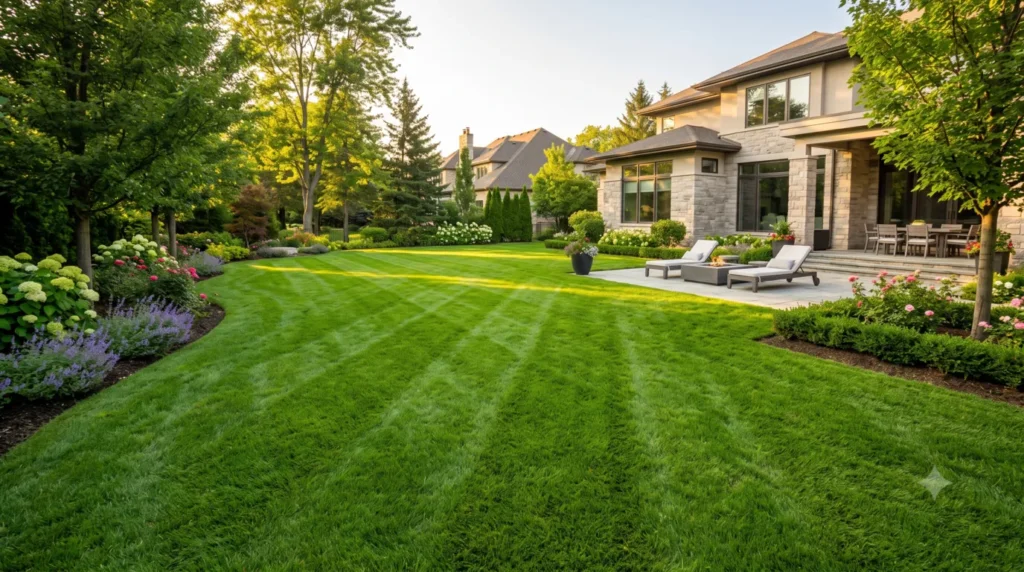
Invest your time and money into mechanical core aeration, high-quality organic topdressing, and smart cultural habits like raising your mower blades. By feeding the living ecosystem beneath your feet instead of trying to fight it with aggregate, you will naturally transform your hard clay yard into a lush, soft, vibrant green oasis that easily handles the toughest summer heat.