Lawn Spreaders for Seed and Fertilizer: Pick the Size That Fits Your Yard
Published
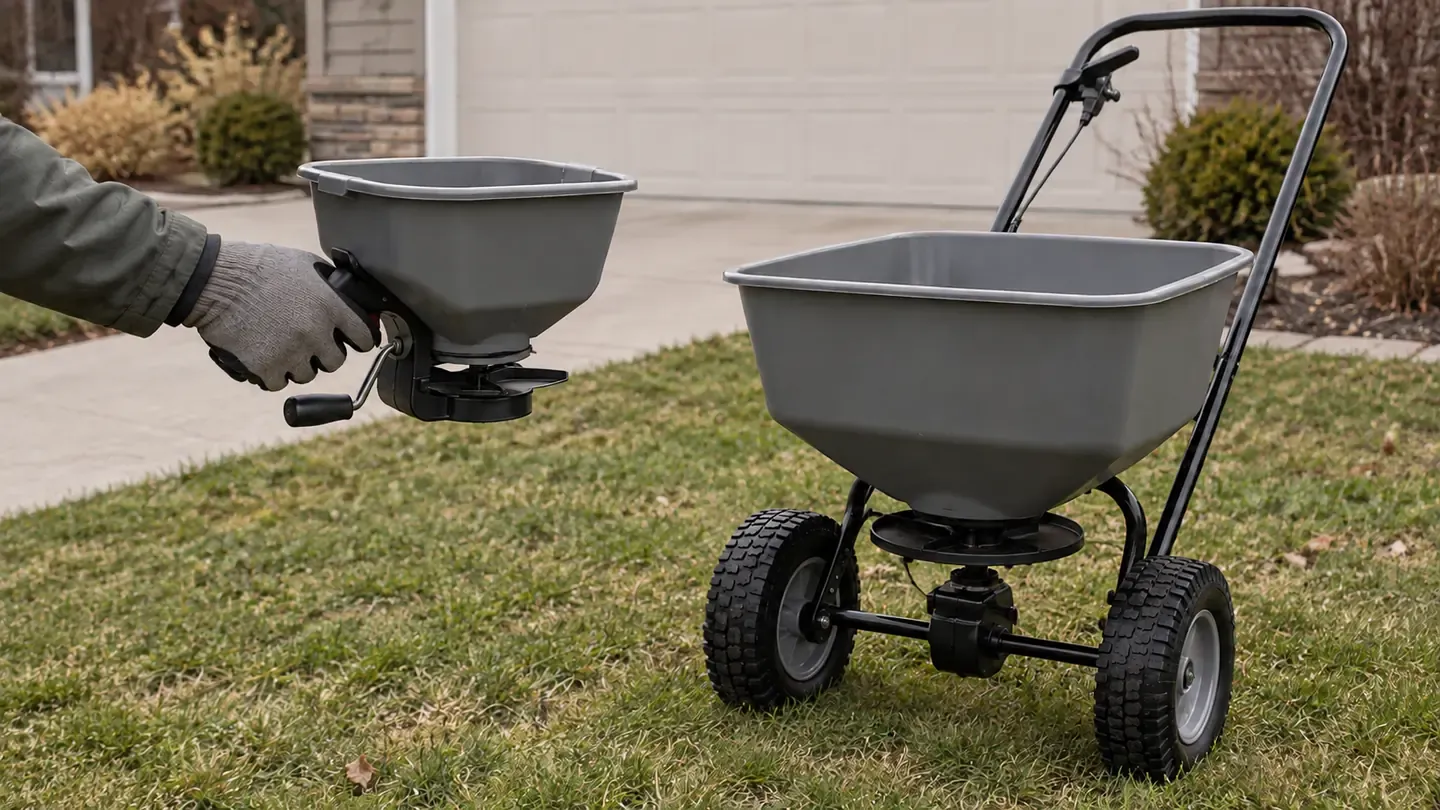
Overseeding, feeding, and putting down a granular weed control all come down to the same job: getting the right amount of product spread evenly across the lawn. Doing it by hand almost always leaves heavy patches and thin strips. A spreader you can set to the rate on the bag fixes most of that.
The right spreader depends mainly on how much lawn you cover in one session and what that ground is like to walk on. Clay lawns tend to be the awkward kind: bumpy after a wet winter, rutted where someone drove on them, and hard as a road by late summer. That makes wheel size and frame strength matter more than they would on a smooth suburban lawn.
Which kind of spreader do you need?
| Handheld | Broadcast push spreader | Drop spreader | |
|---|---|---|---|
| Best job | Bare patches, small lawns, tight spots | Most whole-lawn feeding and seeding | Precise strips next to beds, paths, or water |
| How it spreads | Throws product in a fan as you crank | A spinning rotor throws product several feet to each side | Product falls straight down between the wheels |
| Speed on a big lawn | Slow and tiring | Fast, because each pass covers a wide band | Slow, because each pass covers only the hopper width |
| Main risk | Uneven rate if your cranking speed changes | Product thrown into beds or onto the driveway | Visible stripes if passes miss or overlap |
For most homeowners, a broadcast push spreader is the right default. It covers a lawn quickly, and small gaps between passes blend in because the spread pattern feathers out at the edges. A drop spreader makes more sense for narrow lawns surrounded by beds, but it punishes sloppy lines, so it is a harder tool to get good results with.
Scotts Whirl: for patches and very small lawns
The Whirl is the right tool when you are not really treating a whole lawn. Reseeding a dog-worn patch, overseeding a thin strip along the fence, or feeding a small front yard does not justify a push spreader that takes up space in the garage.
It holds enough product for up to about 1,500 square feet, and you set the flow with a dial while you crank. Scotts prints Whirl settings on the back of its own bags, which removes most of the guesswork with Scotts products.
The limit is consistency. A hand-crank spreader depends on you walking and cranking at a steady pace, so it is less even than a wheeled spreader over a larger area. Scotts itself recommends a non-hand-crank broadcast spreader for its combination weed-and-feed products, so step up to a push spreader if that is what you plan to apply.
Scotts Turf Builder EdgeGuard Mini: for small to medium lawns
For a typical lawn up to roughly 5,000 square feet, the EdgeGuard Mini is the one I would look at first. It is a wheeled broadcast spreader, so the spread rate stays tied to your walking speed instead of your cranking arm, and it covers a small lawn in a few passes.
Its main practical advantage is the EdgeGuard lever. Flip it, and the spreader blocks the right side of the pattern, so you can run along a driveway, sidewalk, or flower bed without throwing fertilizer onto it. Granules on hard surfaces are wasted, and they can wash into storm drains.
It comes assembled and calibrated, and Scotts lists its settings on Scotts lawn products. The smaller hopper means more refilling on a larger lawn, and it is a lighter consumer spreader rather than one built for rough ground. If your lawn is mostly smooth and not too big, that tradeoff is fine.
Scotts Elite: for large lawns
The Elite is worth the extra cost when you are covering a big lawn, up to about 20,000 square feet per fill. Its dual rotors throw a pattern about 6 feet wide, which means fewer passes and fewer refills than the EdgeGuard Mini.
It rolls on 10-inch foam-filled tires that cannot go flat. That is useful on a clay lawn that has firmed up with bumps and old ruts, where small plastic wheels tend to bounce and jolt the spread pattern. It also has the EdgeGuard lever for edges along drives and beds.
If your lawn is under about 5,000 square feet, the Elite is more spreader than you need. The EdgeGuard Mini does the same basic job for less money and storage space.
EarthWay 2150: for rough ground and heavy use
The EarthWay 2150 is a commercial-style push spreader for readers whose yard is hard on equipment. It runs on 13-inch air-filled stud tires and has a fully enclosed gearbox, so dirt and grit stay out of the gears that drive the spinner. The frame is epoxy coated, and the handle adjusts to three heights.
The large tires are the reason to choose it on a clay property. They roll over bumps, dried ridges, and uneven ground better than smaller wheels, so the spreader stays steadier. That helps keep the pattern even. The 50-pound hopper also suits a large lawn, where refilling every few passes gets old quickly.
It also has side-spread control for edges. The tradeoff is that it does not come with a library of settings printed on fertilizer bags the way Scotts spreaders do. Expect to use EarthWay’s own setting chart or calibrate it yourself, which is not hard but takes a little time the first time.
Getting the setting right
The rate setting matters more than the spreader. Too much fertilizer can burn grass and waste money, and too little seed leaves a thin stand.
- Use the bag first. Scotts bags list settings for Scotts spreaders, and Scotts has an online lookup for the exact dial number. Other brands often list settings for several common spreaders.
- If your spreader is not listed, start low and make two passes in a crisscross pattern. It is easier to add a little more than to undo too much.
- Close the hopper when you stop or turn. Most heavy patches come from leaving the flow open while standing still.
Spreading on clay
Clay changes the timing more than the tool.
Wait until the surface is firm enough that you do not leave footprints or wheel ruts. Pushing a loaded spreader across saturated clay compacts the soil you are trying to improve. It also tends to clog the hopper and wheels with mud.
Avoid fertilizing right before heavy rain. A firm or compacted clay surface takes in water slowly, so a downpour is more likely to wash granules off the lawn than into the root zone. A light rain or watering afterward, as the label directs, is what you want.
When you are overseeding, spreading is only one step. Seed needs contact with soil, so aerating first and topdressing afterward usually matter as much as an even spread. Our fall overseeding guide walks through the full sequence, and the grass seed guide helps match the seed to your climate and shade.
Which one should you buy?
If you only patch bare spots or have a very small lawn, the Whirl is enough and stores in a cupboard. For most suburban lawns up to about 5,000 square feet, the EdgeGuard Mini is the practical choice. Larger lawns justify the Elite, and the EarthWay 2150 is the better buy if rough, bumpy ground or heavy use would wear out a lighter consumer spreader.
If you already own a broadcast spreader that rolls smoothly and holds its setting, you probably do not need a new one. Check that the rotor spins freely and the flow gate closes fully, and keep using it.