Manual vs. Powered Core Aerator: Which Fits Your Lawn?
Published
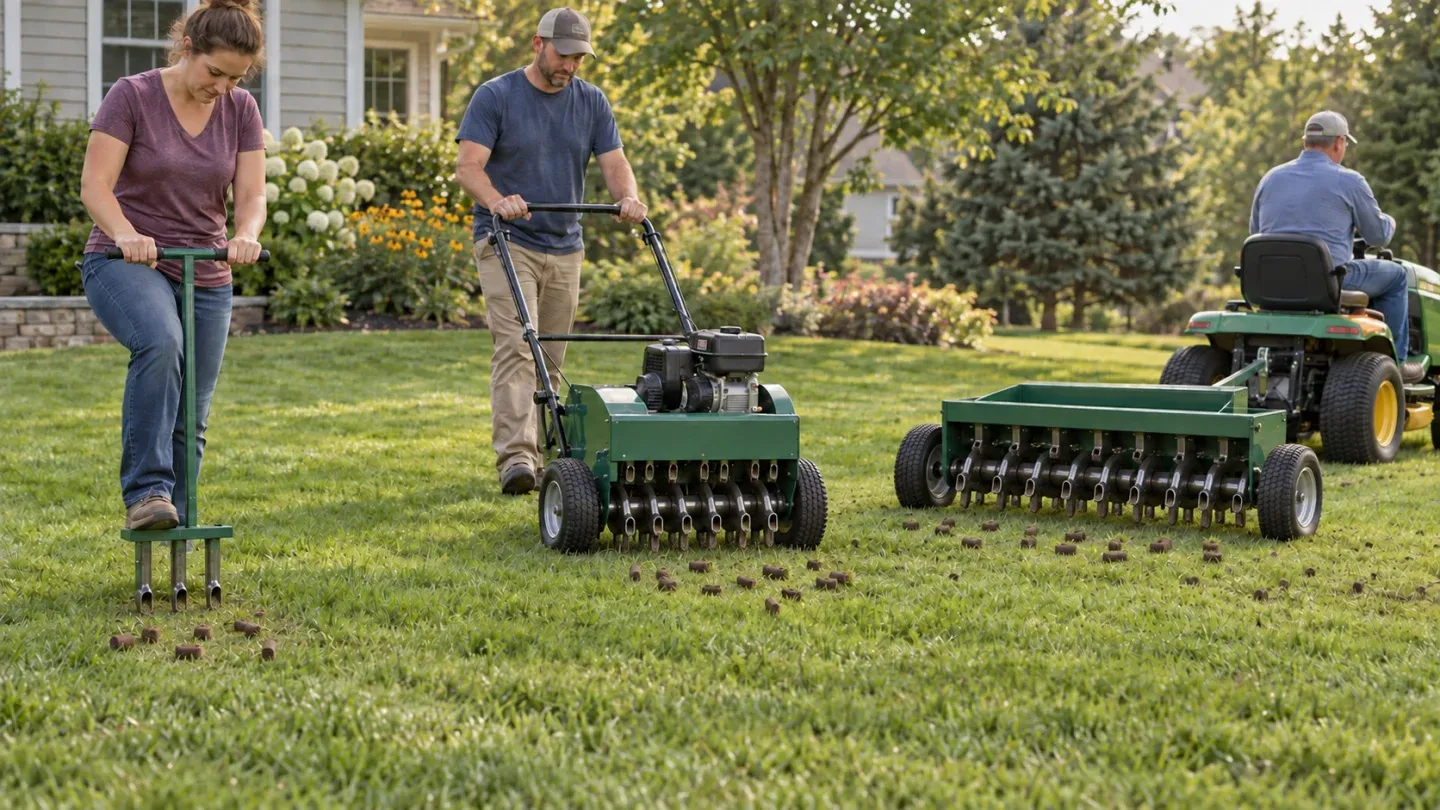
A hand aerator can be just right for the worn strip beside a path. It becomes a tiring way to cover an entire backyard. A powered walk-behind machine covers ground more efficiently, but getting it home and controlling it are part of the job. A tow-behind aerator can suit a large open yard if a suitable mower or tractor is already in the shed.
All three choices here use hollow tines that remove soil plugs. If you are deciding between plug and solid-spike tools, start with the core-versus-spike explanation. If you already know you need core aeration, choose equipment for the area that actually needs treatment, not just the size of your property.
The three choices at a glance
| Decision point | Manual core aerator | Powered walk-behind | Tow-behind plug aerator |
|---|---|---|---|
| Best job | A few patches or a small, awkward area | Widespread shallow compaction | A larger, open area with suitable towing equipment |
| Job scale | Slow across a whole lawn | Covers a medium or large work area efficiently | Covers broad, open ground efficiently |
| Physical effort | Repeated stepping, pulling, and repositioning | Less hand work per area, but a heavy machine still needs control | Little hand coring; towing and handling the attachment still matter |
| Speed | Slowest as the area grows | Faster coverage once on site | Faster on long, unobstructed passes |
| Plugs and penetration | Easy to inspect each spot; depth depends on soil and force | Can make regular passes; check actual cores, not tine length | Check actual cores; moisture and permitted ballast affect penetration |
| Tight spaces | Easy to position around edges | Check gate width, turning space, and obstacles | Needs clearance for both vehicle and attachment, plus wide turns |
| Transport and storage | Easy to carry and store | Rental pickup or delivery may be needed; no long-term storage if rented | No rental trip if owned, but needs storage for the attachment |
| Cost fit | Simple purchase for repeat spot work | Rent for occasional whole-lawn jobs; compare a service quote | Ownership is easier to justify when you already own a compatible tow vehicle |
| Compacted clay | Useful for small areas when clay is moist and workable | Useful for wider areas when clay is moist and firm enough to carry the machine | Useful on open ground only when clay can support the towing vehicle without rutting |
| Main limit | Effort and time | Transport, weight, and control | Vehicle compatibility, access, turns, and ballast limits |
These are practical job matches, not acreage cutoffs or promises that one tool always pulls deeper plugs. Soil moisture, tine condition, machine design, and the ground under the turf affect the result. Make a short test pass and inspect the cores before committing to the whole area.
Choose a manual aerator for a small work area
A manual hollow-tine tool is easiest to justify when you can point to the compacted spots: a worn entrance, a strip near a path, or a small lawn with awkward corners. You can carry it through a narrow gate, work around beds, and put it away without arranging transport or storage for a machine.
The tradeoff is repeated effort. Each step removes only a few plugs, and a useful pattern may require many insertions. Hard, dry clay can stop the tines; muddy clay can clog them. Wait for soil that is moist enough to release a plug without smearing. If a few test insertions are already difficult, covering the entire lawn by hand is unlikely to be a good plan.
If this scale fits your yard, our manual core aerator guide compares tool layouts. If your choice has narrowed to two common hand tools, the Yard Butler and Walensee comparison explains the difference. Neither page changes the basic scale limit of hand work.
Rent a powered walk-behind for broad compaction
When much of the lawn needs plugs removed, a powered walk-behind core aerator usually offers a better balance of coverage and effort than repeated hand coring. Renting is sensible for an occasional job because you use the machine for the day without finding year-round storage or taking on its upkeep. Compare the rental’s total cost, pickup or delivery, and your available time with a local service quote; there is no universal price point where one wins.
Plan the route before reserving a machine. Ask the rental provider for its overall width, transport weight, loading requirements, operating demonstration, and slope limits. Check gates, steps, beds, tight turns, and the vehicle or trailer needed to move it. A powered aerator reduces hand work per square foot, but it can still be heavy to load, turn, and control. If transport or safe handling is the obstacle, hire a lawn-care service instead.
A rental does not guarantee better plugs than a hand tool. Test an accessible strip and inspect the cores. The clay-lawn aeration walkthrough covers moisture, timing, obstacles, and coverage once you have chosen the equipment.
Use a tow-behind only when the whole setup fits
A tow-behind plug aerator can cover long runs on a larger, open lawn. It is most attractive when you already own a lawn tractor or other vehicle that its manufacturer permits you to use for towing. Buying a tow vehicle solely to aerate an occasional lawn is a very different decision.
Check the towing vehicle’s manual and the aerator’s manual together: hitch, towing capacity, added ballast, speed, and slope rules all matter. Some attachments allow weight on a tray to improve penetration, but more weight is not a substitute for workable soil. The vehicle and aerator must fit every gate and storage opening, and you need room to turn without dragging engaged tines around beds or trees. A walk-behind machine or service may suit a large yard better when access is narrow or the lawn is broken into small sections.
If you have the vehicle and the space, our tow-behind plug aerator comparison covers attachment widths, clearance, and model-specific limits.
Make the choice in this order
- Treat the affected area, not the whole property by default. A few worn patches can suit a manual tool even on a large lot. Widespread shallow compaction shifts the decision toward powered coverage.
- Check the soil before choosing equipment. Workable clay is moist but not muddy. If a test produces no real plugs or the ground ruts, postpone the job instead of forcing a heavier tool through it.
- Walk the access route. Measure the narrowest gate and look at steps, slopes, sharp turns, beds, irrigation, and buried lines. Check the exact machine’s dimensions and manual; a nominal working width is not its overall width.
- Be honest about effort and logistics. Hand coring takes many repetitions. A rental needs transport and control. A tow-behind needs a compatible vehicle, safe terrain, and storage. If those requirements make the job difficult, get a service quote.
- Consider how often you will really use it. Owning a hand tool for recurring spots is simple. Occasional whole-lawn work often favors renting or hiring. Tow-behind ownership makes more sense when you already have the towing setup and expect repeat use.
There is no reliable universal square-foot line between these choices. Even a small, densely compacted area may be too demanding for hand work, while a larger lawn with only one worn path may need little more than spot work.
When to put the aerator away
Do not choose a bigger aerator until you know aeration addresses the problem. If the ground is firm because it is dry, reassess after rain or watering. If the lawn is spongy above the soil, check for thatch. If the cause is unclear, use the compacted-clay diagnosis before buying or renting anything.
Postpone aeration on waterlogged soil or ground so dry that tines cannot pull cores. Repeated puddles in the same low place can signal a grading or drainage problem that holes cannot fix; start with the standing-water guide. Deep construction damage sits below the reach of ordinary lawn aerators and may need professional assessment. A steep or obstructed site can also make a service the safer practical choice, subject to the operator’s equipment and site assessment.
After aeration
Leave extracted cores to dry and break apart unless they create a specific problem. Topdressing and seed are separate decisions, not automatic steps. If suitable material would help the soil, see how to topdress without burying the grass. For thin cool-season turf in fall, follow the overseeding guide and choose grass seed for your climate and site. You can stop after aeration when the grass is already healthy.
A couple of common decisions
Is a tow-behind as effective as a powered walk-behind?
Both can remove soil plugs when their tines penetrate and release cores. Neither format guarantees a better result on its own. Soil moisture, tine design, ballast where permitted, and coverage matter. Choose by access and the equipment you can safely use, then verify the plugs in a test strip.
Should I rent or hire someone?
Rent when you can transport and operate the machine safely and have time to do the job during a suitable soil and grass-growth window. Hire a service when loading, slopes, tight access, or physical effort make the rental impractical. Ask what equipment the service will use and whether it will remove actual cores.
Further reading
- Iowa State University Extension: Core Aeration of Lawns for hollow tines, soil moisture, rental and service options, and the plugs a core aerator should remove.
- Penn State Extension: Lawn Management through the Seasons for compaction relief, hollow tines, and moisture-dependent penetration.
- Bluebird: 530 Lawn Aerator specifications and operator manual for an example of a powered machine’s transport, weight, and slope considerations. Check the actual rental model.
- Agri-Fab: 45-0299 operator manual for tow-behind ballast, turning, transport, and slope considerations. Check the actual attachment and towing-vehicle manuals.